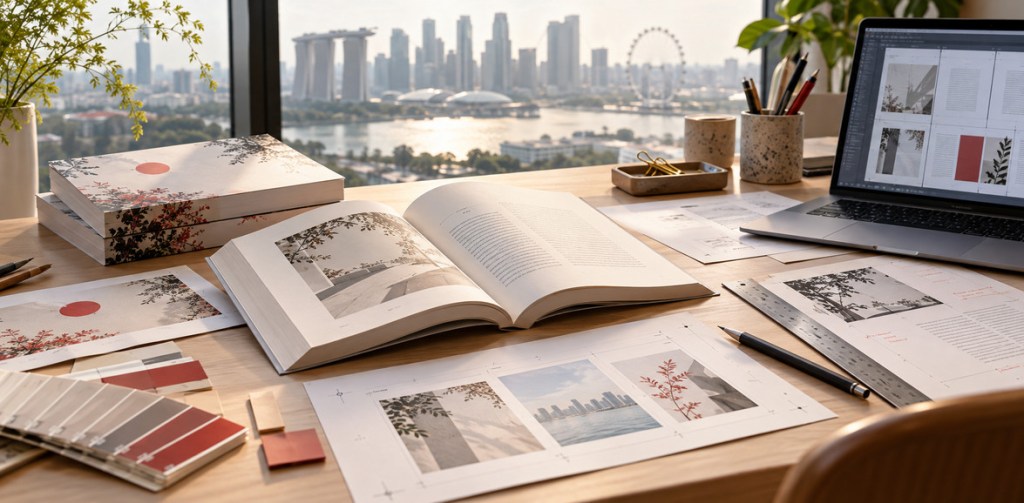
Writing the book is one achievement. Getting it into somebody else’s hands, looking and feeling like a book worth keeping, is another.
There is something quite satisfying about holding a properly printed book. The weight of it, the texture of the paper, the way the cover folds around the spine. Even the smell of fresh ink has its appeal, although anyone who has worked in print production long enough knows that the romance tends to disappear somewhere around the third round of printer corrections.
For someone who has spent years, perhaps decades, working on a manuscript, the prospect of finally turning it into a physical book can be enormously appealing. It might be a novel, a memoir, a collection of family recipes, a photography book, a children’s story or even a business guide built from years of professional experience.
In Singapore, self-publishing has become a practical option for people who want to see their work in print without necessarily going through a traditional publishing house. Digital printing, print-on-demand platforms and online distribution have made producing smaller quantities more accessible than in the past. What hasn’t changed is the amount of work required to turn a manuscript into a publication that people will actually want to read.
And that is where things become interesting from a designer’s point of view.
Do you actually need a publisher?
Traditionally, getting a book published meant finding a publisher willing to invest in the manuscript. The publisher would typically oversee editing, design, production, printing, distribution and marketing, with the author receiving royalties under an agreed contract.
Self-publishing approaches the process differently. The author takes responsibility for the decisions, expenses and commercial risks that would otherwise be handled by a publisher. In return, there is greater control over the content, presentation, production schedule and how the finished book reaches its readers.
For some writers, that independence is precisely the attraction. They may have a particular vision for their work or a relatively small, clearly defined audience. Others may simply want to publish something that would not fit comfortably into a commercial publisher’s catalogue.
A family history does not necessarily need a national bookshop launch. A photography collection might be produced as a limited edition. A retired professional might want to publish lessons accumulated over a long career. A small business could produce an illustrated guide or a book documenting its history. None of these projects necessarily requires a traditional publishing deal. They do, however, require realistic planning.
Before you print anything, decide what sort of book you are making
One of the first questions I would ask an aspiring author is not how many pages the manuscript contains, but what they intend to do with the finished book. Will it be sold commercially? Given away to family and friends? Used as a promotional publication? Distributed at an exhibition or event? Made available internationally through an online platform?
The answers influence almost every production decision. A 200-page novel intended for general readers might work perfectly well as a modest paperback with black-and-white interior pages. A photography book needs considerably more attention to paper, colour reproduction and image placement. A children’s picture book places different demands on illustration, pacing, typography and durability.
Even the size of the book matters. A5 is a familiar, practical format for many publications in Singapore, but it is not necessarily the right answer for every project. A landscape photography book, for example, might benefit from a wider format, while a poetry collection may work better as something smaller and more intimate. These decisions are worth making before the entire manuscript has been laid out. Changing the size of a finished 200-page book is rarely as painless as changing the dimensions of a PowerPoint slide.
Editing and proofreading: the work nobody should skip
A finished manuscript is not automatically a publication-ready manuscript. Even experienced writers benefit from another pair of eyes. Developmental editing can help with structure, pacing and clarity, while copy-editing addresses consistency, grammar, spelling and expression. Proofreading comes later, ideally after the manuscript has been typeset, to catch errors that may have survived earlier rounds.
These are different jobs, and their costs should be considered separately. I would encourage any first-time author to set aside part of the publishing budget for editorial work before spending money on elaborate cover treatments or premium paper. A beautiful book containing distracting errors is still a book containing distracting errors.
For a small personal publication, the editorial requirements may be modest. For a commercially distributed novel or non-fiction title, a more substantial editorial review may be worthwhile. The important thing is to establish a reasonably stable manuscript before the design work begins. Rewriting entire chapters after a book has been typeset can mean rebuilding pagination, moving illustrations and revising the contents and index. It can be done, but it is better to allow for it rather than discover the problem at the printing deadline.
Book cover design: the first conversation with your reader
People are regularly told not to judge books by their covers. Anyone who has spent time in a bookshop knows how optimistic that advice is.
A book cover does several jobs simultaneously. It identifies the title and author, communicates something about the subject or genre, and establishes the visual character of the publication before anyone reads the first paragraph.
For a self-published author, the temptation is often to assemble something quickly using an online design template. There is nothing inherently wrong with that. Templates can be useful starting points, particularly for personal projects with limited budgets. Problems arise when the cover looks interchangeable with dozens of other titles, or when the design has been created without considering the physical book.
The front cover is only part of the job. A complete paperback cover also needs a spine, a back cover, suitable typography, space for publication information and potentially an ISBN barcode. The spine width depends on the final page count, paper specification and binding method. A cover that looks impressive as a flat image on a monitor may not survive the transition to a printed object.
At The Odd Hat Creative, I can help develop a cover direction around the manuscript, its intended audience and the practical requirements of production. The aim is not simply to make something attractive. It is to produce a cover that belongs to the book and works beyond the screen.
Interior layout: where publishing becomes a design discipline
This is probably the part of book production that readers notice least when it has been done properly, and notice immediately when it hasn’t.
Open a well-designed book and the typography feels natural. Paragraphs are comfortable to read, headings are consistent, margins provide enough breathing room and page numbers appear where you expect them. Nothing seems particularly remarkable. That apparent simplicity takes work.
Interior book design involves decisions about typefaces, line spacing, paragraph styles, margins, chapter openings, running headers, folios and page breaks. Illustrated publications introduce additional considerations involving captions, image placement, tables and how visual material interacts with text.
A manuscript created in Microsoft Word or Google Docs can be perfectly suitable for writing, but that does not automatically make it ready for commercial printing. Professional page-layout software allows for more precise control over typography, grids, image placement, master pages and the preparation of production files. Equally important, it helps maintain consistency across a long document.
Having worked across editorial design, publications and print production, I tend to pay attention to the less glamorous details: awkward line endings, inconsistent indents, images that are too small for reproduction, and headings stranded at the bottom of a page. These may seem minor when viewed individually. Across an entire book, they make a considerable difference.
ISBNs and legal deposit: what Singapore authors should know
Singapore has its own administrative requirements for published books, and these are worth understanding early in the process.
Getting an ISBN
An International Standard Book Number, or ISBN, identifies a particular publication and edition. It is commonly used by bookshops, distributors, libraries and online retailers to manage and identify books. In Singapore, ISBN applications are handled by the National Library Board (NLB) through its Deposit Portal.
Authors planning to self-publish should check which publication details are required and whether they need separate ISBNs for different editions or formats. A paperback and an eBook, for example, generally require separate ISBNs when both are assigned ISBNs. An ISBN is not the same as copyright registration, and having one does not automatically mean a book will be stocked by retailers. It is a publishing identifier, not a guarantee of commercial distribution.
For a small private book intended only for family members, an ISBN may not be necessary. For a book intended for commercial circulation, it is sensible to consider one.
Understanding legal deposit
Under Singapore’s National Library Board Act, publishers of covered Singapore publications are required to deposit copies with the NLB within four weeks of publication. The standard requirement is two copies for a physical publication, or one copy for an applicable digital publication. The precise obligation depends on the material and how it is published.
This is part of Singapore’s effort to preserve its published heritage. Self-published books are not automatically outside the requirement simply because the author is also the publisher. Authors should consult the NLB Deposit Portal and the National Library Board Act for current procedures and obligations.
What about copyright?
Original literary and artistic works generally receive copyright protection automatically in Singapore when the legal requirements are satisfied. Authors do not need to register their manuscripts simply to create copyright protection. However, publishing a book also means checking permissions for material created by other people. Photographs, illustrations, song lyrics, long quotations and previously published material may require appropriate permission or licensing.
This becomes particularly important for memoirs, historical publications and illustrated books assembled from different sources. The Intellectual Property Office of Singapore provides guidance on copyright and ownership.
Printing your book in Singapore: how many copies should you make?
Once the manuscript, cover and interior design are ready, the next decision is printing. Singapore has commercial printers offering short-run digital printing and larger offset print runs. Some authors also use print-on-demand services that produce copies individually as orders arrive. There is no universally correct method. Each has advantages and limitations.
Digital short-run printing can be useful for an initial batch of books, a small personal edition or a project intended for a limited audience. It avoids the commitment of a large inventory, although the cost per copy may be higher.
Offset printing can become more economical per copy when quantities increase, but it usually involves greater initial expenditure and additional planning. An author ordering several hundred or a thousand copies should also think about storage, delivery and how those books will actually be sold.
Print-on-demand avoids much of the inventory problem by producing books as customers order them. Platforms such as Amazon Kindle Direct Publishing offer this model, although available markets, fulfilment, formats and pricing need to be checked against the author’s intended readership.
I would generally advise a first-time author against ordering a large quantity simply because the printer offers an attractive unit price. A thousand books sitting in cartons are not necessarily a thousand future sales. They may simply be a rather expensive new piece of furniture. It is often more useful to start by understanding demand and comparing a few practical production scenarios.
Paper, binding and the details that affect the final result
Paper selection influences more than appearance. It affects the book’s weight, thickness, readability, colour reproduction and cost. A text-heavy novel usually benefits from comfortable, relatively lightweight uncoated paper. Photography and illustrated publications may need different stocks to reproduce images effectively. A workbook might require paper that can be written on without excessive show-through.
Binding presents another set of choices. Perfect binding is familiar from commercial paperbacks, while case binding is commonly used for hardcovers. Saddle stitching suits thinner booklets, and spiral or wire binding can be practical for manuals and workbooks that need to lie flat.
There are also production details that can cause trouble if they are overlooked: bleed, trim size, safe margins, image resolution, embedded fonts, colour settings and the exact dimensions of the finished cover. These are not especially glamorous considerations. They are, however, the difference between a file that merely looks finished and one a printer can use reliably.
This is an area where The Odd Hat Creative can provide practical support: preparing publication artwork, checking production requirements, refining layouts and helping authors communicate more clearly with their chosen printer. Printing itself can be arranged separately, according to the project’s scale, budget and requirements.
How much does self-publishing cost in Singapore?
This is usually where the conversation becomes more serious. There is no single reliable price for self-publishing a book because two books with the same page count can involve very different amounts of work.
A 150-page novel with a completed manuscript, a straightforward cover and black-and-white text pages is a very different undertaking from a 150-page illustrated cookbook containing original photography, recipes, captions and carefully art-directed layouts. A realistic publishing budget should consider the following:
- Editing and proofreading: How much editorial work is necessary before layout begins?
- Cover design: Is it a straightforward typographic cover or a more developed visual concept?
- Interior design and typesetting: How long is the manuscript, and how complicated is the page structure?
- Photography and illustration: Are suitable assets already available, and are the necessary rights secured?
- Printing and binding: What are the specifications and quantities, and where will the books be printed?
- Distribution and promotion: Will the book be sold directly, distributed through retailers or made available online?
There is also a financial distinction worth making between the cost of producing a book and the cost of selling one. If a book has a retail price of S$25, the author does not necessarily receive S$25 from every sale. Printing, transaction charges, retailer discounts, distribution fees and fulfilment costs can reduce the amount retained. Before settling on the retail price, it makes sense to work backwards from the actual production and selling costs.
For The Odd Hat Creative, design and production artwork would be quoted according to the manuscript, required deliverables and complexity of the project. I would rather establish the scope properly than offer a flat rate that ignores whether the book contains 80 pages of text or 200 pages of photographs and illustrations. Sometimes the most useful design advice is to simplify the project before spending more money on it.
Getting your self-published book into readers’ hands
Producing a book is only half the publishing process. Distribution is a separate challenge. An independent author in Singapore might choose to sell directly through a personal website, approach suitable independent bookshops, participate in book fairs or events, or use an online publishing platform.
Each approach involves different economics and practical requirements. Bookshops may have selection criteria and commercial terms, and some may not accept unsolicited self-published titles at all. Direct selling provides greater control but requires the author to manage orders, payments, packaging and delivery. Online platforms may provide broader reach, but their fees and available services need to be evaluated.
The correct approach depends on the book. A specialised professional guide with a clearly identified audience may sell perfectly well through direct enquiries and workshops. An illustrated local-history book might benefit from community events or organisations interested in the subject. A novel intended for an international audience may require a different strategy.
It is worth deciding how the book will reach its audience before committing to the first print run, rather than treating marketing as something to consider after the cartons arrive.
Where The Odd Hat Creative fits into the process
I am not positioning The Odd Hat Creative as a traditional publishing house. The studio’s role is more specific: helping authors and independent publishers turn their content into well-designed, properly prepared publications.
Depending on the stage of the project, that can involve developing the visual direction for a book, designing its cover, creating interior page layouts, working with supplied photography or illustrations, cleaning up existing artwork and preparing final files for print. It can also mean stepping into a project that is already partly finished.
Perhaps the manuscript has been laid out in Word, but the result does not quite look like a book. Maybe the cover has been assembled in Canva, but the printer needs a correctly sized, production-ready file. Or perhaps the author has already commissioned illustrations and needs somebody to bring everything together into a coherent publication.
Not every project needs a complete redesign or a large creative team. Sometimes what is missing is simply someone who understands typography, editorial layout and what happens between an approved design and a finished printed object.
The Odd Hat Creative’s design and production services are built around that sort of practical work. The author remains responsible for the publishing decisions, rights, distribution and overall project. Editorial services, printing arrangements and other specialist requirements can be agreed separately where needed. It is a collaborative approach rather than an all-inclusive publishing package.
A few things I would tell anyone self-publishing their first book
If I were sitting down with someone planning their first book, I would probably begin by asking them to show me what they already have. Not the perfectly polished presentation of what they hope to make, but the actual manuscript, the photographs, the rough cover sketch and whatever notes they have collected along the way.
From there, the practical questions tend to become clearer. Is the manuscript genuinely ready for design? Who is the intended reader? How many copies might realistically be needed? Is this something the author hopes to sell commercially, or a project they simply want to see completed properly?
I would also encourage them to budget for a physical proof before approving the full print run. A printed sample reveals things that a screen often conceals, from uncomfortable type sizes to unexpected colour shifts and awkward binding margins.
Most importantly, I would suggest resisting the temptation to make every decision at once. A book is a sequence of related production decisions, and getting them in the right order usually saves money and frustration.
Your book deserves more than a hurried PDF
There is a particular pleasure in seeing a manuscript become something tangible. The words that once existed as an untidy collection of files, drafts and revisions finally occupy actual pages. There is a cover, a spine and a finished object that can be passed from one person to another. For an independent author, that moment can mean a great deal.
But getting there involves more than choosing a typeface, placing an image on the cover and pressing Export. Self-publishing gives authors considerable freedom, along with the responsibility of making decisions that traditional publishers would normally handle. Professional design is one part of that process, but it is an important one because it influences how the finished book is experienced.
Thinking of self-publishing a book in Singapore? If you have a manuscript, a rough layout or an existing book design that needs professional attention, get in touch with The Odd Hat Creative. Tell me what you are making, how far along you are and what you need help finishing. I can look at the design and production requirements, suggest a sensible scope and provide a quotation for the work involved.
You do not need to arrive with a perfect brief. An unfinished manuscript and a reasonably clear idea of what you want the finished book to be are useful places to start. The writing is yours. My part is helping it find its way onto the page.



Leave a Reply