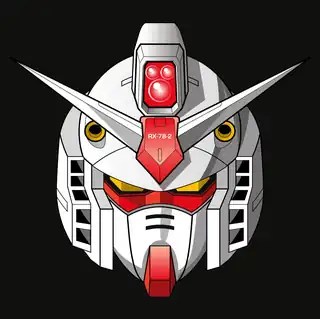
Personal project · Vector illustration · Unofficial fan art
Some mechanical designs are recognisable long before you see the rest of the machine. Gundam is particularly good at this. A V-fin, a visor, the shape of a faceplate or even a single mono-eye can be enough to identify a mobile suit from across the room.
That was what interested me about this personal series.
Rather than illustrating complete mobile suits, I reduced each one to a front-facing head portrait and treated the designs almost like a collection of graphic emblems. The challenge was to keep enough of the original mechanical character for each machine to remain immediately recognisable, while translating complicated three-dimensional forms into cleaner vector shapes.
It eventually became less about drawing individual Gundams and more about building a consistent visual system for all of them.
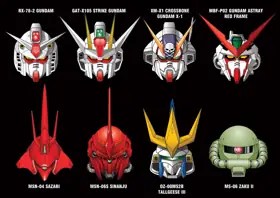
Reducing the machine to its face
Gundam head designs share a visual vocabulary, but the differences between them become obvious once you start looking closely.
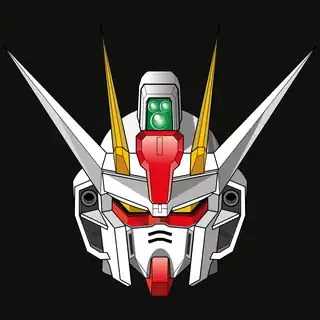
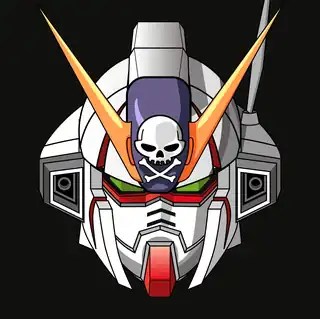
The original RX-78-2 Gundam has the familiar white armour, red centre section, yellow eyes and broad V-fin that established much of the visual language that followed. XM-X1 Crossbone Gundam X-1 becomes immediately identifiable through its skull-and-crossbones forehead detail and orange fins. GAT-X105 Strike Gundam feels sharper and more vertically structured, while MBF-P02 Gundam Astray Red Frame pushes the V-fin into a much more dominant graphic element.
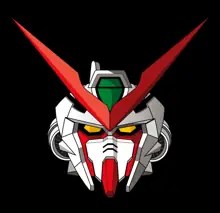
The red mobile suits presented a different problem altogether. MSN-04 Sazabi is broad and flowing, while MSN-06S Sinanju is denser and more layered. Then there are designs that barely follow the conventional Gundam face at all. OZ-00MS2B Tallgeese III is dominated by its enormous gold crest, and the MS-06 Zaku II is reduced almost entirely to its helmet silhouette, breathing tubes and single mono-eye.
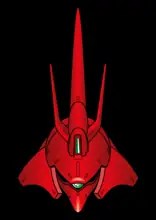
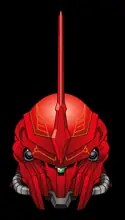
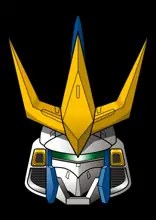
Placed side by side, they become a study in how much personality mechanical designers can create from roughly the same basic components.
Building a consistent vector language
For the series, I kept the presentation deliberately controlled: front-facing composition, black background, strong outlines, simplified planes of colour and restrained highlights.
The individual machines obviously differ enormously, but I wanted them to feel as though they belonged to the same collection rather than being eight unrelated drawings.
That meant making choices about what to retain and what to simplify. Mechanical illustrations can very quickly disappear into panel lines and small details. At this scale, every piece of detail has to justify itself. Some parts could be reduced to a single shape. Others — the Crossbone skull, the Sazabi sensors, the Tallgeese crest or the Zaku mono-eye — were essential because they carry so much of the identity of the design.
The black background became part of the system as well. It strips away any environmental context and lets the silhouette, colour blocking and facial geometry do all the work.
The series so far
- RX-78-2 Gundam
- XM-X1 Crossbone Gundam X-1
- GAT-X105 Strike Gundam
- MBF-P02 Gundam Astray Red Frame
- MSN-04 Sazabi
- MSN-06S Sinanju
- OZ-00MS2B Tallgeese III
- MS-06 Zaku II
I like seeing them together almost as much as I like the individual portraits. Once assembled into a group, the similarities arrive first, followed by all the little departures from the standard Gundam formula.
It is basically a mechanical family portrait.
Why this belongs in my portfolio
Most of my professional work has involved brands, publications, packaging, campaigns and production artwork. This series exercises a different part of the same design brain.
There is still hierarchy. There is still simplification. There is still the question of how much visual information an image actually needs. And there is the discipline of creating one illustration and then making several more without allowing the rules to drift.
The subject happens to be Gundam, which is already part of my own long-running interests, but the exercise itself is really about visual systems and consistency.
Personal work is useful that way. Nobody supplied a brief, nobody requested a format and there was no client approval waiting at the end. I could simply choose something I wanted to draw and see where the series went.
For now, eight mobile suits feels less like an ending than the start of a much larger wall of robot heads.
This is a self-initiated, unofficial fan-art project and was not commissioned by or produced in association with Bandai Namco, Sunrise or the owners of the Gundam franchise. Gundam, mobile suit names and associated character/mechanical designs remain the property of their respective rights holders.